A 25 piece test run and a 25,000 piece production run are not the same purchase. One buys information, the other buys unit economics. Cannabis operators who understand the difference stop wasting money on labels for strains that never make it to a second harvest.
This is the decision framework we walk operators through, with the actual per piece numbers behind it.
The core economics
Traditional label printing has a fixed cost floor. Flexographic presses need plates, one per color, cut for your specific artwork. Those plates cost money whether you print 500 labels or 50,000, so the per piece price only becomes attractive once the plate cost is spread across a large run. That is why legacy label shops quote 5,000 piece minimums.
Digital UV printing has no plate. The file goes to press, the press prints it. There is no setup fee to amortize, which is why a 25 piece run is a real product rather than a favor.
What that does to your cost curve:
| Quantity | Per label (2 x 3 in laminated) | Total | Cost per label vs 25 |
| --- | --- | --- | --- |
| 25 | ~$1.50 | ~$38 | baseline |
| 100 | ~$0.95 | ~$95 | 37% cheaper |
| 250 | ~$0.72 | ~$180 | 52% cheaper |
| 500 | ~$0.55 | ~$275 | 63% cheaper |
| 1,000 | ~$0.38 | ~$380 | 75% cheaper |
| 2,500 | ~$0.27 | ~$675 | 82% cheaper |
| 5,000 | ~$0.19 | ~$950 | 87% cheaper |
| 10,000 | ~$0.14 | ~$1,400 | 91% cheaper |
Figures are representative for a standard size on laminated stock and move with size, material and finish. The shape of the curve is the point: the steepest savings happen between 25 and 1,000. After about 5,000 the curve flattens hard.
Where the curve flattens is where the decision lives
Going from 100 to 1,000 labels cuts your per piece cost by 60 percent. Going from 5,000 to 10,000 cuts it by another 26 percent. The first jump is transformative. The second is a rounding error against the risk of holding 10,000 labels for a SKU you might retire.
So the question is never "what is the cheapest per label price." It is "what is the smallest quantity that gets me past the steep part of the curve for a SKU I am confident about."
For most cannabis operators that answer is 1,000 to 2,500 per confirmed SKU.
When small batch is the right call
New strain, unproven demand. Cannabis SKU churn is brutal. A cultivar that tests great and sells poorly is a normal outcome. Print 100 labels, run the drop, see what the sell through looks like. Artwork not final. If the label has not survived contact with a real jar under real display lighting, do not print 10,000 of it. Order 25, apply them, put a jar on a shelf, look at it from six feet away. Limited drop or collab. Seasonal releases, artist collabs and single harvest runs by definition do not repeat. Compliance in flux. If your state is mid rule change, short runs keep you from stranding inventory when the warning language updates. Testing finishes. Order the same artwork on gloss, matte, clear and holographic at 25 pieces each. That comparison costs a fraction of a single production run and it settles the argument permanently.When large run is the right call
Core SKUs. Your three best sellers that have shipped for four quarters. Print those deep. Shared components. Exit bag stickers, compliance panels, warning labels and QR panels that are identical across every SKU. These have no strain risk at all, so buy them at volume. Applicator lines. If you are applying by machine, you need roll delivery with a specified core size and wind direction, and rolls make no sense in tiny quantities. Locked artwork with variable data split out. This is the professional pattern. Print the static brand label deep, print the batch and potency panel shallow and often.The static plus variable split, explained
This single technique saves cannabis operators more money than any other labeling decision.
Your label contains two kinds of information. Static: logo, strain name, brand colors, licensee info, warning block. Variable: batch number, harvest or package date, potency percentages, test date, COA QR code.
Static information changes rarely. Variable information changes every batch. Printing both on one label means every new lab result renders your remaining inventory of labels obsolete.
Split them:
You keep the volume price on the expensive, design heavy piece and pay short run pricing only on the small piece that genuinely has to change. Across a year of monthly batches the savings run into the thousands per SKU.
Sheets versus rolls versus die cut singles
| Delivery | Best for | Cost position |
| --- | --- | --- |
| Sheets | Many SKUs, short runs, hand application | Cheapest at low quantity |
| Rolls | High volume, machine or fast hand application | Cheapest at high quantity |
| Die cut singles | Merch stickers, exit bags, handouts | Priced per piece by size |
If you are hand applying a few hundred labels across six strains, sheet labels will beat rolls on both price and convenience. If you are applying thousands on a line, rolls win decisively.
Reorder cadence that actually works
The operators who spend the least on labels do three things.
Add a standing reorder trigger at roughly 20 percent remaining stock. Running out of labels stops a packaging line, and rush pricing on an emergency reorder erases whatever the volume discount saved you.
Why no setup fee changes the math
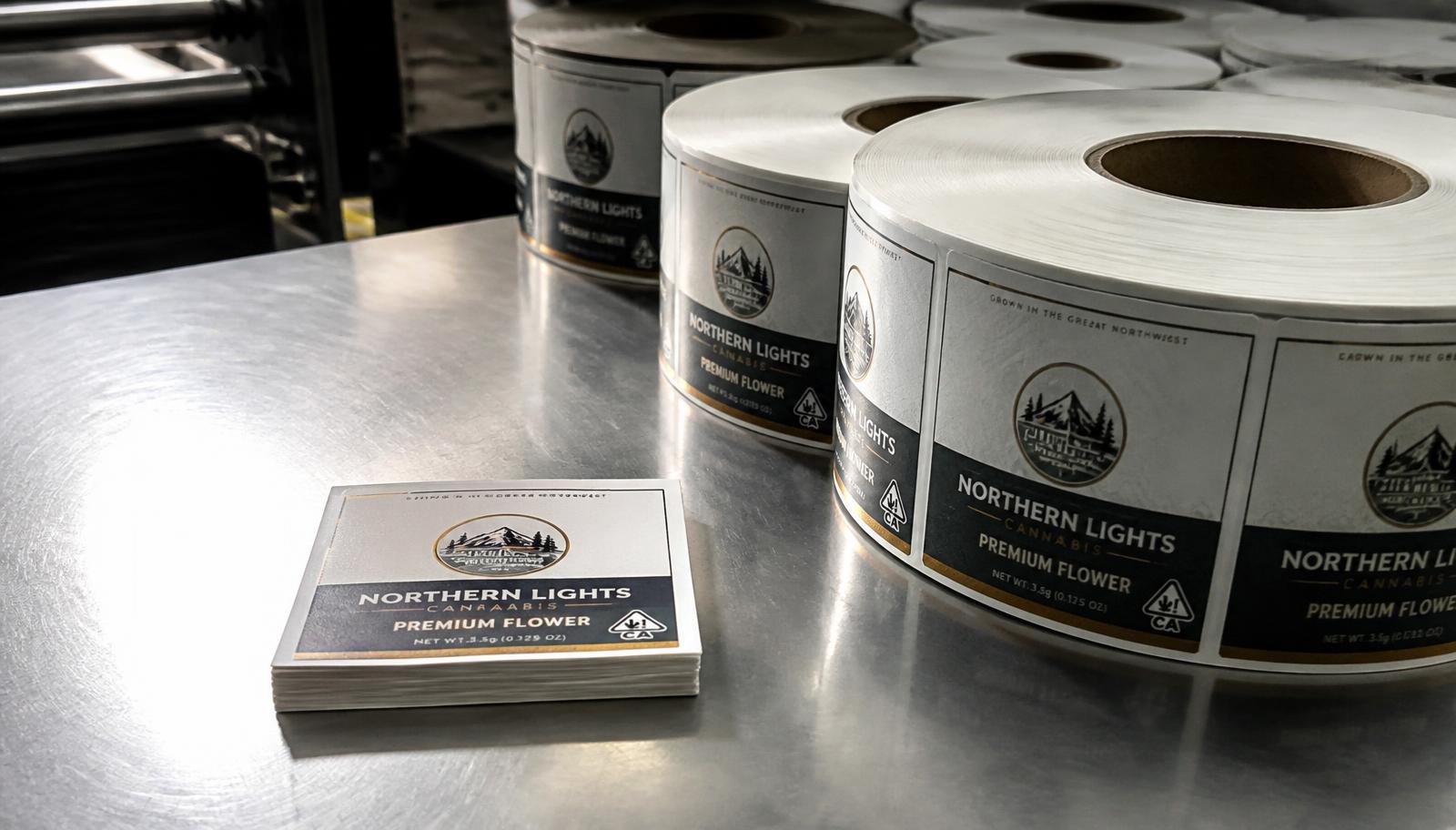
Because we print digitally on 11 color presses at our own facilities in Florida and Greenville, South Carolina, and cut on Summa and Kongsberg equipment in house, there is no plate to charge you for. That removes the artificial minimum that pushes operators into buying 5,000 labels for a strain they have never sold. Full production detail: inside an 11 color cannabis label facility.
Frequently asked questions
What is your actual minimum?25 pieces, with no setup or plate fee.
Is the material different on a short run?No. Same laminated stock, same presses, same cutters. Only the price per piece changes.
Can I mix strains in one order?Yes. Multiple designs can be laid out on sheets, or run as separate rolls in one order.
How long do labels keep on a shelf?Stored flat, cool and dry, the adhesive stays good for well over a year. Heat and humidity in a storage room are the enemy, not time alone.
Should I print potency on the main label?Only if your potency is stable batch to batch, which for most flower it is not. Split it onto a variable panel. See what does TAC mean on a cannabis label.
Where do I price this out? Cannabis labels for jars, pouches and tubes. Cannabis die cut stickers for merch. Or start at the cannabis hub.