TAC means total active cannabinoids. Here is how it differs from THC and total THC, how labs calculate it, and how to lay out a potency panel that stays legible.
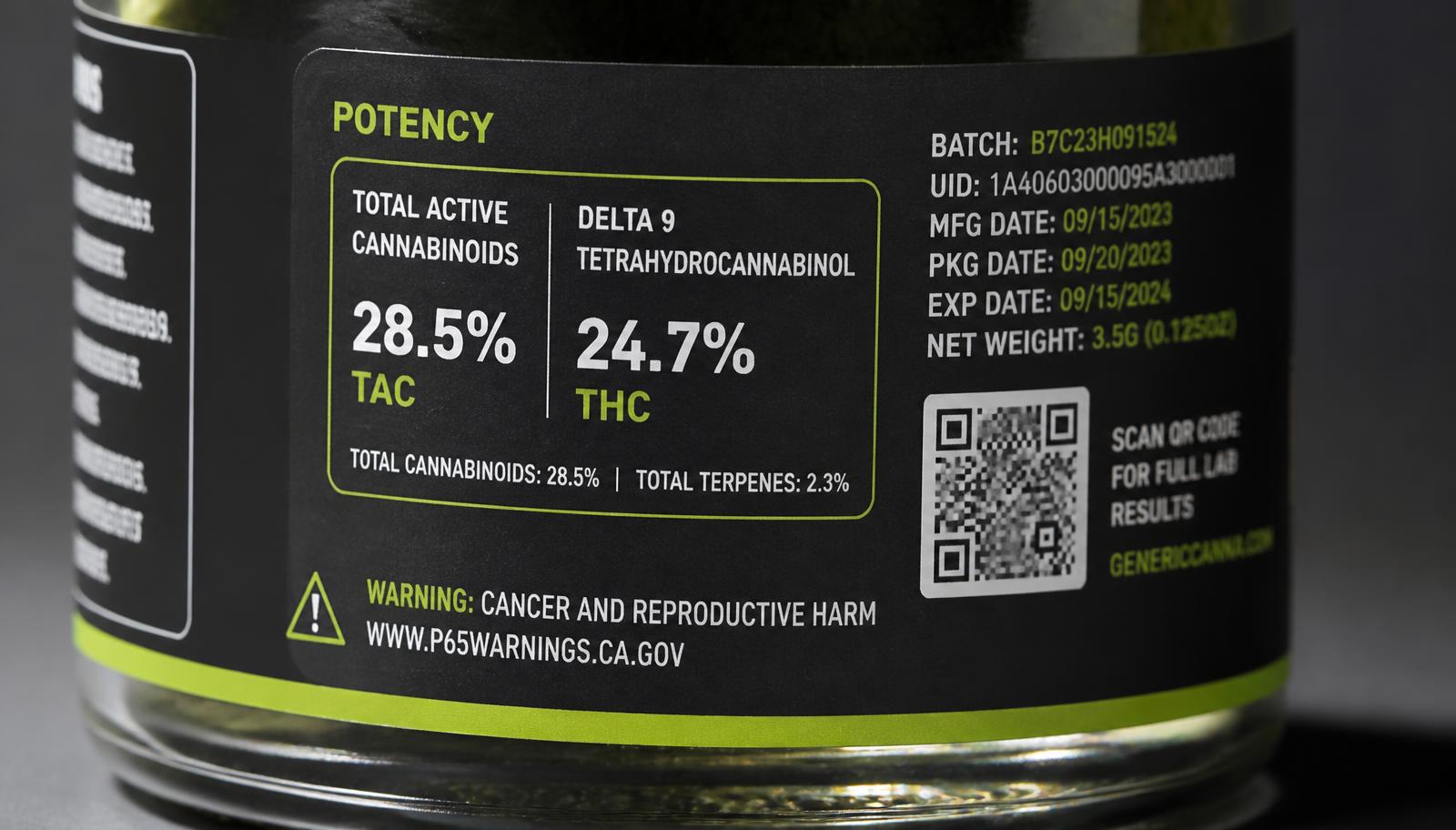
TAC stands for total active cannabinoids. On a cannabis label it is the combined percentage of every cannabinoid the lab detected in an activated state, not just THC. A jar can read 24.7 percent THC and 28.5 percent TAC on the same panel, and both numbers are correct: TAC is the larger figure because it includes CBD, CBG, CBN, THCV and the rest of the minor cannabinoids alongside the THC.
That is the whole answer. The rest of this page explains why the two numbers differ, how labs calculate them, why TAC keeps showing up on more packaging, and what it means for the label you are about to print.
TAC vs THC vs total THC
Three numbers show up on modern cannabis packaging and they are routinely confused.
| Term | What it counts | Typical value on flower |
| --- | --- | --- |
| THC (delta 9) | Only activated delta 9 THC in the sample as tested | 0.3 to 5 percent on raw flower |
| Total THC | Delta 9 THC plus THCA converted by a decarboxylation factor | 18 to 32 percent |
| TAC | Every detected cannabinoid, activated and acid forms converted | 20 to 36 percent |
Raw cannabis contains very little delta 9 THC. It contains THCA, the acid precursor, which converts to THC when heated. Labs apply the standard conversion factor of 0.877 because THCA loses a carboxyl group during decarboxylation and therefore loses mass.
The usual formula:
Total THC = THC + (THCA x 0.877)
TAC extends the same logic across the whole cannabinoid profile:
TAC = sum of all detected cannabinoids, with each acid form multiplied by its conversion factor
So a flower that tests at 1.2 percent THC and 27.5 percent THCA gives you a total THC of about 25.3 percent. Add 0.8 percent CBG, 0.4 percent CBD and traces of CBN and THCV, and TAC lands somewhere near 27 percent. Same jar, three defensible numbers, and only one of them belongs in the big type on your label.
Why TAC appears on more labels every year
Three reasons.
Entourage marketing. Brands that invest in cultivar diversity want credit for minor cannabinoids and terpenes, not just for a THC number. TAC is the metric that rewards a full profile.
Consumer education. Budtenders have spent years explaining that a 32 percent THC jar is not automatically a better experience than a 22 percent jar with a rich terpene profile. TAC gives them a second number to point at.
Potency inflation pushback. THC only labeling created an arms race, and some of it is testing shopping rather than better growing. TAC is harder to game because it reflects the whole panel.
None of that changes what a regulator requires. In most programs total THC and total CBD are the mandated disclosures, and TAC is an optional addition. Confirm with your state before you design the panel.
Reading a potency panel
A well built potency panel usually contains:
Total THC and total CBD, in the mandated format and type size
TAC, if the brand chooses to include it
Total terpenes, increasingly common on premium flower
Batch or lot number tying the panel to the certificate of analysis
Test date and testing lab
A QR code that resolves to the full COA
The QR code is the part most operators underinvest in. Print it at 0.6 inches square or larger, keep the quiet zone clear, use dark code on light background, and scan the actual printed proof under dispensary lighting before you approve a run of 5,000. We print COA codes on dedicated white panels for exactly this reason. See cannabis QR code stickers.
The label design problem TAC creates
Adding TAC means adding another number in an area of the label that is already the most crowded part of the panel. Three things keep it readable.
Give potency its own block. A bordered or reversed panel that groups THC, TAC and terpenes reads faster than three numbers floating in the layout.
Do not put potency over a photo. Gradient backgrounds behind small numerals is the single most common reason a proof comes back illegible.
Use a real number hierarchy. One headline figure, two supporting figures at a smaller weight. Two competing 28 point numbers just confuse the customer.
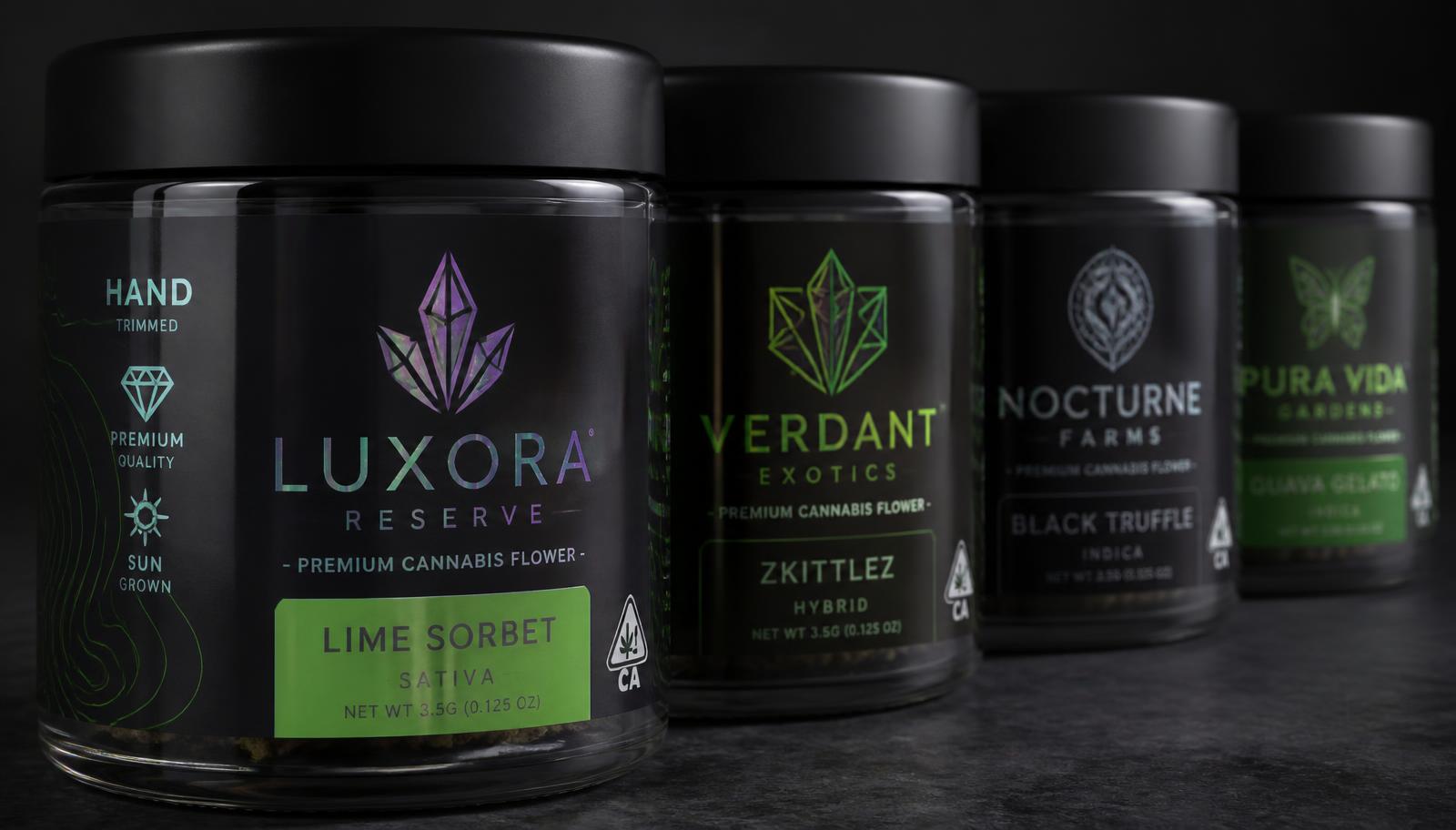
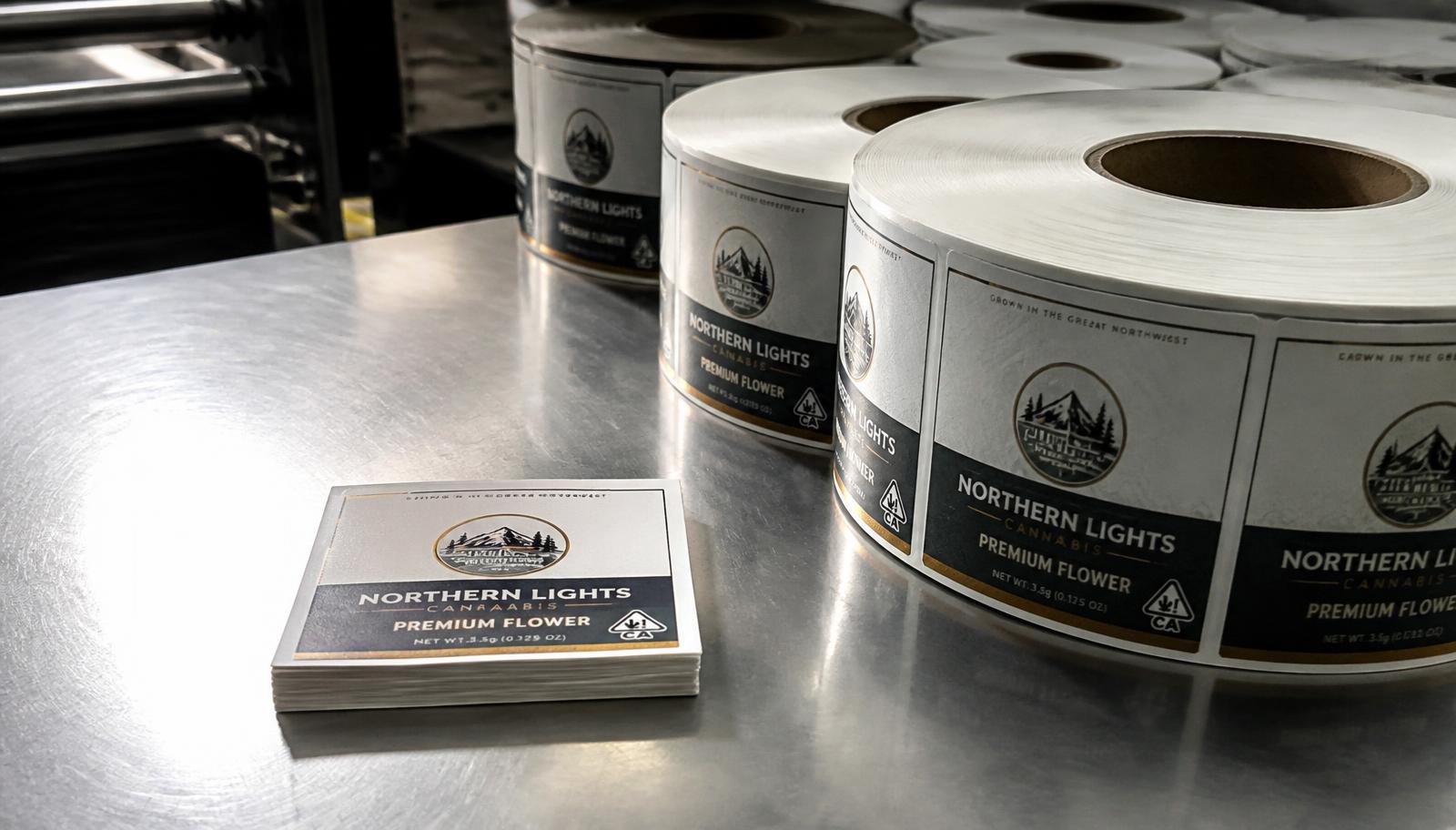
Because potency changes batch to batch, most operators split the artwork: a static brand label plus a small variable potency and batch label. That way a new lab result does not obsolete 8,000 printed brand labels. Both pieces print on the same waterproof laminated stock, and both hold up to jar condensation.
Print quality matters more than people expect on a potency panel
Small type in a dense information block is where cheap printing shows. Four color process at low resolution fills in the counters of 5 and 6 point type and turns a percentage sign into a smudge. We print on 11 color Epson UltraChrome and Mimaki UV systems, which hold fine type crisp and keep dark brand colors dense without plugging the small copy sitting on top of them. Cutting runs on Summa flatbed and Kongsberg X24 CNC equipment across our Florida and Greenville, South Carolina facilities.
If a regulator cannot read your warning block, or a customer cannot read your potency, the label failed regardless of how good the logo looks.
Quick reference
TAC = total active cannabinoids, the sum of the whole cannabinoid panel
Total THC = THC + (THCA x 0.877)
TAC is almost always higher than total THC on the same product
TAC is usually optional; total THC and total CBD are usually mandated
Potency changes per batch, so plan for a variable data panel
Frequently asked questions
Is TAC the same as total cannabinoids?
Effectively yes on most labels. Some labs distinguish total cannabinoids (raw sum) from total active cannabinoids (acid forms converted). Read the COA header rather than assuming.
Why is TAC higher than THC?
Because TAC includes CBD, CBG, CBN, THCV and other cannabinoids in addition to THC.
Does a higher TAC mean a stronger product?
Not necessarily. Effect is driven by the ratio of cannabinoids and the terpene profile, not by one aggregate percentage.
Can TAC be lower than total THC?
No. TAC includes THC, so it cannot be smaller. If a label shows that, the panel has an error.
Do I have to put TAC on my label?
In most programs, no. Total THC and total CBD are the common requirements. Verify with your state regulator.
Where do I get labels printed with a potency panel?
Configure size, material, and quantity, instant pricing, free digital proof.
The QR code is the part most operators underinvest in. Print it at 0.6 inches square or larger, keep the quiet zone clear, use dark code on light background, and scan the actual printed proof under dispensary lighting before you approve a run of 5,000. We print COA codes on dedicated white panels for exactly this reason. See cannabis QR code stickers.
Every order on this page is printed, laminated, and cut in-house. No brokers, no outsourcing, no template-only shapes.
More from the blog
Formats, materials, compliance panels, batch codes and real per label pricing for cannabis labels and stickers, written by the factory that prints them.
Real per piece pricing from 25 to 10,000 labels, where the cost curve flattens, and the static plus variable split that saves cannabis operators thousands a year.
Why cannabis labels lift, smear and fade, plus an adhesive selection matrix for cold storage, terpene exposure, mylar pouches and small radius containers.
Order custom labels.
Factory direct prices. 11-color Epson UltraChrome printing. Free shipping over $75. Most orders ship in 3 days.
Design your own, pick a sticker type
Die Cut
Cut to any shape
Kiss Cut
Peel-friendly backing
Multiple designs, one sheet
Rainbow shimmer finish
Transparent vinyl
Scan-to-link
Premium custom stickers made in the USA. Fast turnaround, free shipping on orders over $75.