The elements that appear on nearly every compliant cannabis label, the two rules that get labels rejected, and a pre press checklist to run before you approve a proof.
Cannabis packaging rules are written by state, revised often, and enforced by inspectors who measure type with a loupe. This page is a working checklist for what generally appears on a compliant label and where states differ, so you can lay out a label that will not get rejected. It is not legal advice. Verify every requirement with your state regulator or compliance counsel before you print, because the rules in your program can and do change.
The universal checklist
Nearly every adult use and medical program in the United States requires some version of the following. Build the panel around this list before a single brand element goes on the label.
| Element | What it is | Typical rule |
| --- | --- | --- |
| Product identity | What the product is | Plain language, not just a strain name |
| Net weight or volume | Contents | Metric and imperial, both usually required |
| Potency | Total THC and total CBD | Per package and often per serving |
| Batch or lot number | Ties product to lab results | Must match the COA |
| Dates | Harvest, manufacture, package, expiration | Varies by product type |
| Licensee information | Who made or distributed it | License number, sometimes address |
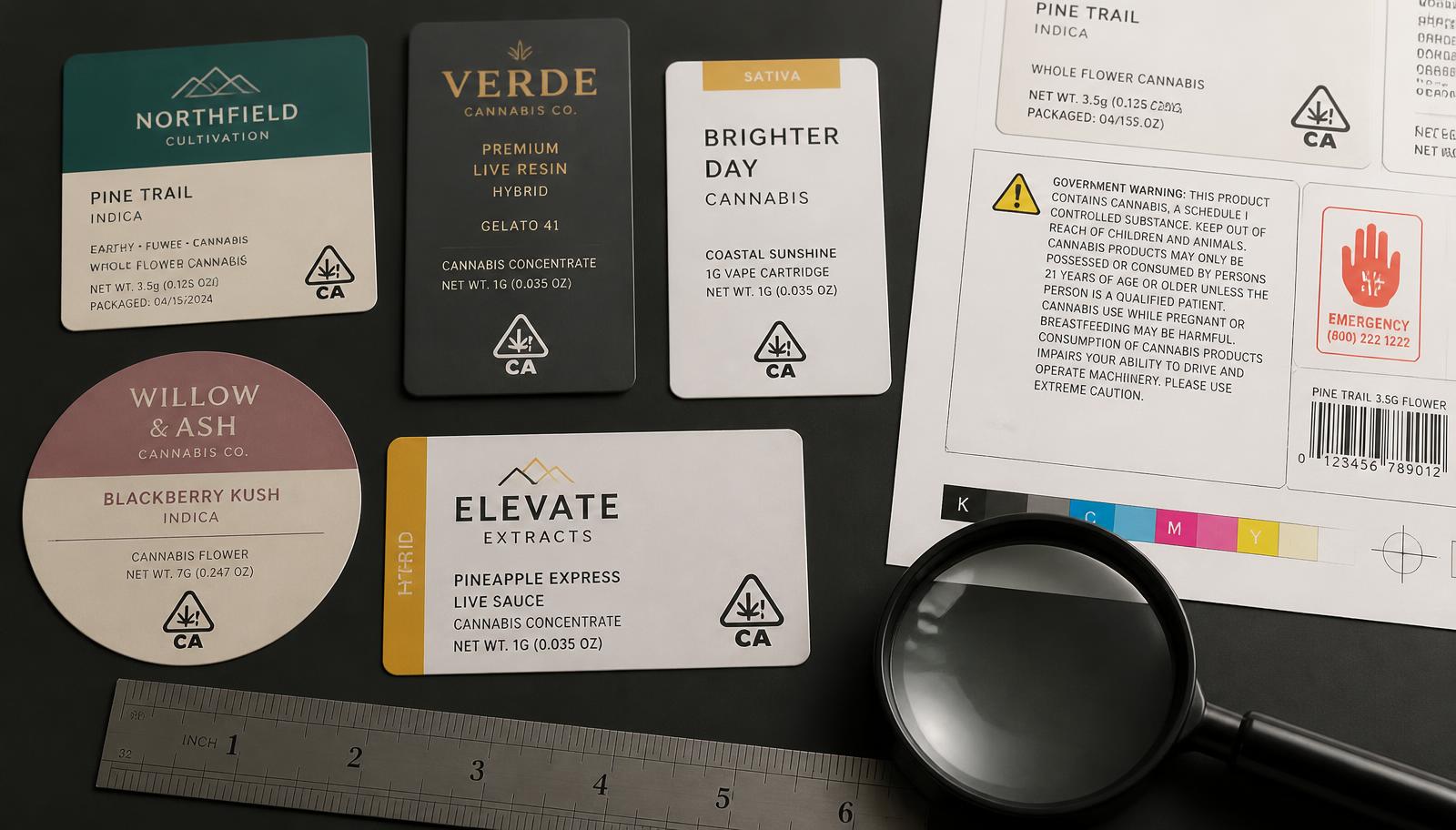
| Universal symbol | State THC warning mark | Minimum height, no recolor, no distortion |
| Government warning | Mandated warning text | Minimum type size, exact wording |
| Keep out of reach of children | Child safety statement | Often folded into the warning block |
| Ingredients and allergens | For edibles and infused products | Descending order by weight |
| COA access | QR code or lot lookup | Increasingly standard |
The two rules that get labels rejected
Minimum type size. Most programs set a floor, commonly in the range of 6 to 8 point for warning text, sometimes larger for the primary panel. Designers routinely shrink the warning block to make room for artwork. Inspectors measure it. Set the warning block at the required size first and treat the remaining area as your design canvas.
Universal symbol integrity. The state symbol has a mandated minimum size, usually specified in inches or millimeters of height, and it typically cannot be recolored, stretched, rotated, outlined or placed over a busy background. Download the current file from your state's own site rather than pulling a version off a design blog. An outdated symbol is a rejection.
Where states differ most
You cannot design one label for every market. The variables that change from state to state:
Symbol artwork. Every program has its own mark, and several have revised theirs in recent years.
Warning wording. The exact sentences are prescribed and differ meaningfully between programs.
Minimum type size. Ranges across programs; some scale the requirement to package size.
Serving size disclosures. Edibles rules are the most divergent area, especially per serving versus per package potency.
Prohibited design elements. Many programs bar cartoon characters, imagery appealing to minors, candy references, or claims about health benefits.
Exit packaging. Some programs regulate the bag as well as the product.
Child resistant packaging. Usually a container requirement rather than a label requirement, but it changes the surface you are labeling.
The practical consequence: if you distribute in three states, plan for three label versions of the same SKU. The brand side stays identical; the compliance panel is swapped. Because we print digitally with no plate fees, running three variants of the same artwork costs no more per piece than running one.
Design rules that keep you out of trouble
Never place warning text or the universal symbol over a photograph or gradient
Keep the compliance panel on a single flat background color with high contrast
Do not reverse small warning type out of a dark field unless your state allows it and it prints cleanly
Reserve a dedicated white panel for variable batch and potency data
Keep 0.125 inch of clear safe margin inside the trim so nothing critical is cut off
Avoid anything that reads as candy branding, cartoon mascots aimed at children, or health claims
Print a physical proof at 100 percent and read it at arm's length before approving
The variable data problem
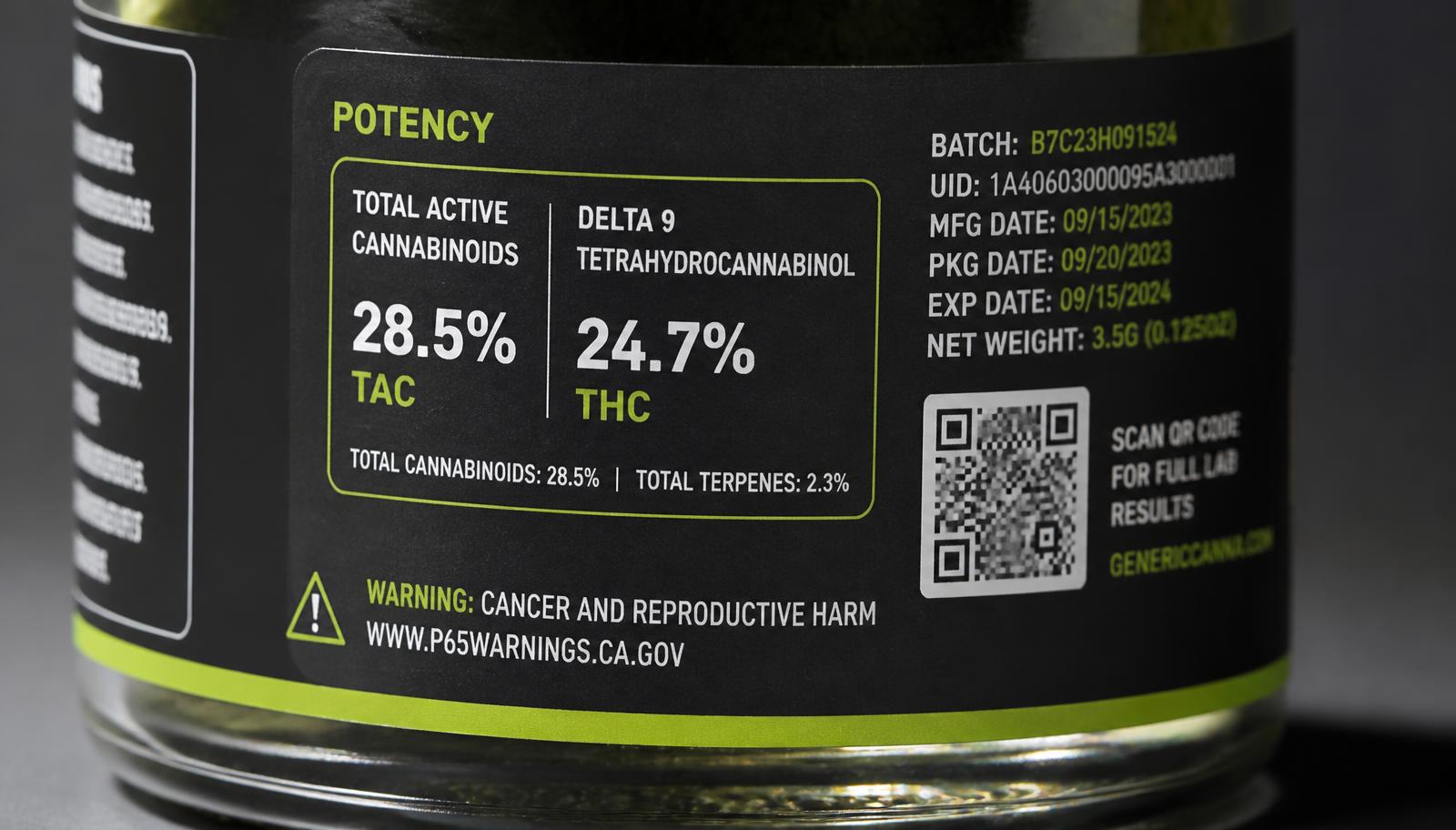
Batch numbers, package dates and potency change every run. Printing them into the main brand label means every new lab result strands your remaining label inventory.
The standard solution is a two piece system. A static brand label carries the logo, product identity, licensee info and warning block. A small variable panel carries batch, dates, potency and the COA QR code. Print the static piece deep at volume pricing and the variable piece shallow and often. The savings math is laid out in small batch vs large run cannabis label printing.
COA QR codes
If your program requires or your customers expect lab result access, the QR code needs to actually scan in a dispensary, not just on your monitor.
Minimum 0.6 inches square, larger is safer
Dark code on a light background, never the reverse
Maintain the quiet zone; do not crowd it with type
Do not print it over a gradient or texture
Test the printed proof under display case lighting with two different phones
Material and print requirements that support compliance
Compliance is not only about content. A warning block that has smeared or faded is no longer legible, and legibility is the actual requirement.
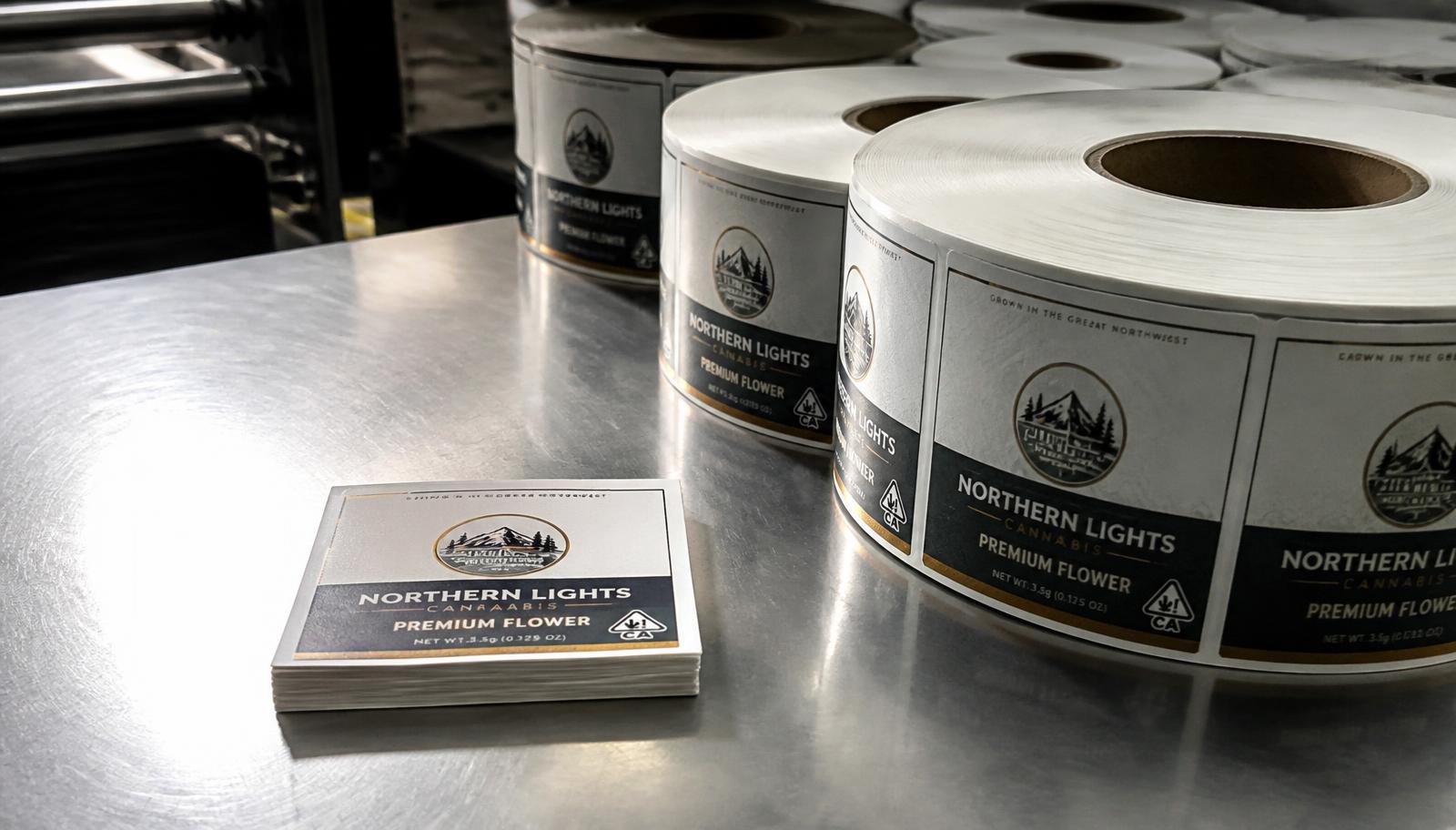
Use laminated waterproof stock so ink cannot smear from handling, condensation or terpene residue. Use a press capable of holding small type crisp. Four color process at low resolution fills in the counters of 6 point type and turns a legible warning into a grey smear. We print on 11 color Epson UltraChrome and Mimaki UV systems on laminated 3M and General Formulations stock, cut on Summa and Kongsberg equipment, at our own facilities in Florida and Greenville, South Carolina. Production detail: inside an 11 color cannabis label facility.
Pre press checklist before you approve
Warning text measured and at or above the required point size
Universal symbol at or above minimum height, unmodified, current version
All required disclosures present for the product type
Batch number matches the COA on file
Net weight in both metric and imperial
License number correct and current
QR code scans from a printed proof, not a screen
0.125 inch bleed, 0.125 inch safe margin, fonts outlined
Physical proof read at arm's length by someone who did not design it
Confirmed against the current rule text on your state regulator's site
What we check and what we do not
We check print readiness on every file: resolution, color, bleed, cut line, registration and whether the smallest type on your label will reproduce legibly. If your warning block is going to print illegibly, we tell you before it runs.
We do not perform legal compliance review. We are printers, not compliance counsel, and the rules in your program are yours to verify. Anyone who tells you otherwise is selling something.
Frequently asked questions
Can you tell me what my state requires?
No. Requirements change and vary by product type. Pull the current rule text from your state regulator and have counsel review it.
Do you have templates for state universal symbols?
Use the current file from your state's own site. Third party copies go stale.
Can I use one label across multiple states?
Rarely. Warning wording and symbols differ. Plan on a compliance panel variant per state with shared brand artwork.
What point size should my warning be?
Whatever your state specifies, commonly in the 6 to 8 point range. Design to your specific requirement, not to a general rule.
How do I handle potency changing every batch?
Split the label into a static brand piece and a variable data piece.
Where do I print compliant labels?Cannabis labels for jars, pouches, tubes and cartons, or start at the cannabis hub.
Printed in our own factory
Why our stickers actually last.
Every order on this page is printed, laminated, and cut in-house at Stickerine. No brokers, no outsourcing, no template-only shapes.
Configure size, material, and quantity, instant pricing, free digital proof.
The standard solution is a two piece system. A static brand label carries the logo, product identity, licensee info and warning block. A small variable panel carries batch, dates, potency and the COA QR code. Print the static piece deep at volume pricing and the variable piece shallow and often. The savings math is laid out in small batch vs large run cannabis label printing.
Use laminated waterproof stock so ink cannot smear from handling, condensation or terpene residue. Use a press capable of holding small type crisp. Four color process at low resolution fills in the counters of 6 point type and turns a legible warning into a grey smear. We print on 11 color Epson UltraChrome and Mimaki UV systems on laminated 3M and General Formulations stock, cut on Summa and Kongsberg equipment, at our own facilities in Florida and Greenville, South Carolina. Production detail: inside an 11 color cannabis label facility.
Where do I print compliant labels? Cannabis labels for jars, pouches, tubes and cartons, or start at the cannabis hub.
Every order on this page is printed, laminated, and cut in-house. No brokers, no outsourcing, no template-only shapes.
More from the blog
Formats, materials, compliance panels, batch codes and real per label pricing for cannabis labels and stickers, written by the factory that prints them.
TAC means total active cannabinoids. Here is how it differs from THC and total THC, how labs calculate it, and how to lay out a potency panel that stays legible.
Real per piece pricing from 25 to 10,000 labels, where the cost curve flattens, and the static plus variable split that saves cannabis operators thousands a year.
Order custom labels.
Factory direct prices. 11-color Epson UltraChrome printing. Free shipping over $75. Most orders ship in 3 days.
Design your own, pick a sticker type
Die Cut
Cut to any shape
Kiss Cut
Peel-friendly backing
Multiple designs, one sheet
Rainbow shimmer finish
Transparent vinyl
Scan-to-link
Premium custom stickers made in the USA. Fast turnaround, free shipping on orders over $75.